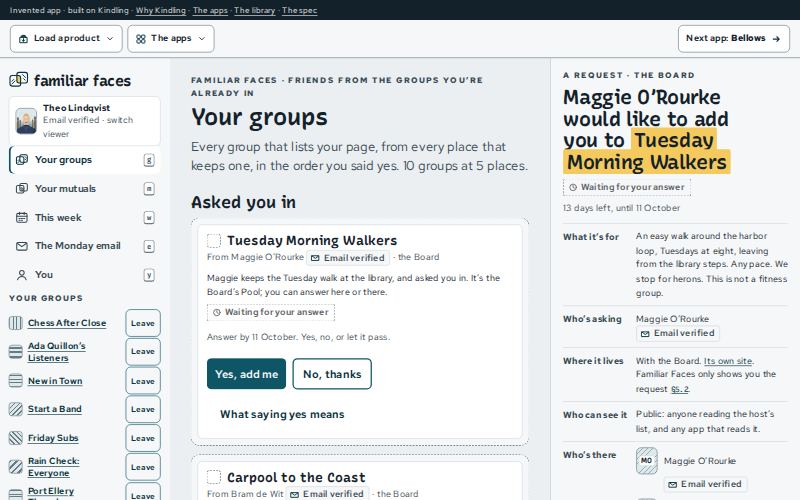
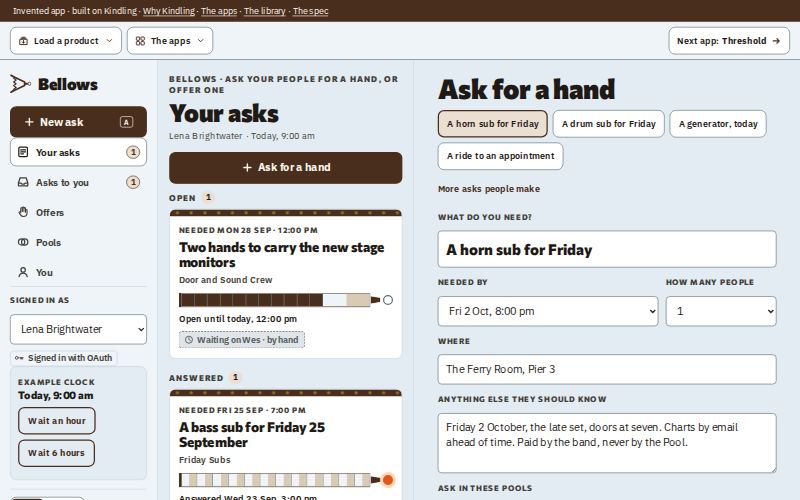
Web apps for finding your way through the Pools the library’s sites keep: on a phone, one thumb; on a desk, a full window. Seven of them: four that read many kinds of Pool, dating among them, one for friends and groups, one for asks and offers, and a desk for the people who keep Pools. None of them owns anyone in it.
Invented apps, working in your browser. Each app opens with an invented person signed in, and everyone in it is invented. They really work: you can say yes, pass, search, ask and leave. Nothing is sent anywhere, and nothing runs at TranquilTech yet.
An app is a reader. It holds nobody: your page stays where you keep it, your Pools stay where their keepers host them, and your conversations go by email. Choose the one that suits you, or use three.
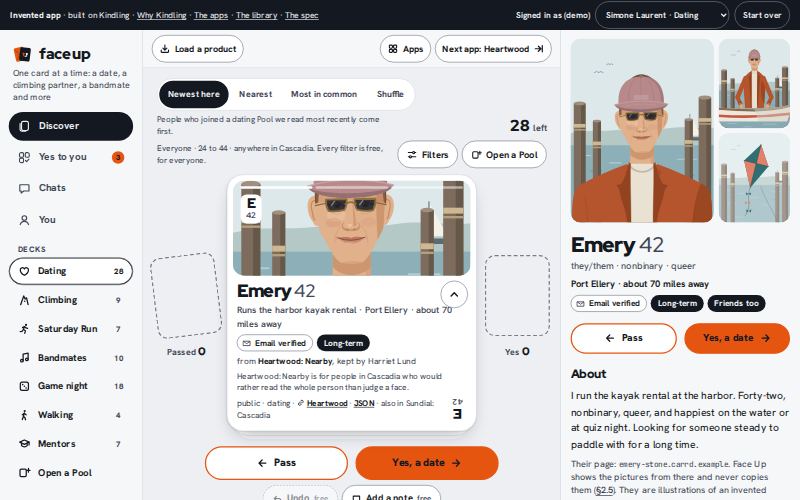
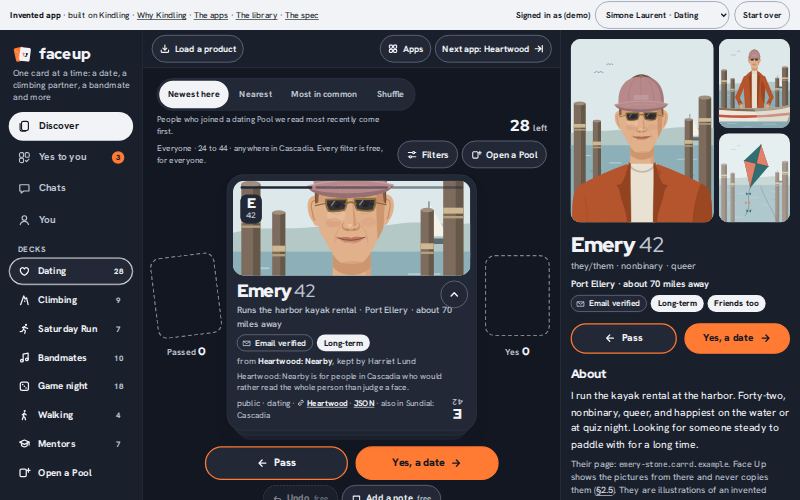
One card at a time, face up, in seven decks: Dating, Climbing, Saturday Run, Bandmates, Game night, Walking and Mentors. Who said yes to you is free in every deck, undo is free, and each deck has an order you choose and can read.
Pools Hosts Face Up: Cascadia. Opens 66 Pools that other people keep, in its decks or under their own names.
Money Free. Ticketed evenings at a bar pay for it; nothing about who sees you is for sale.
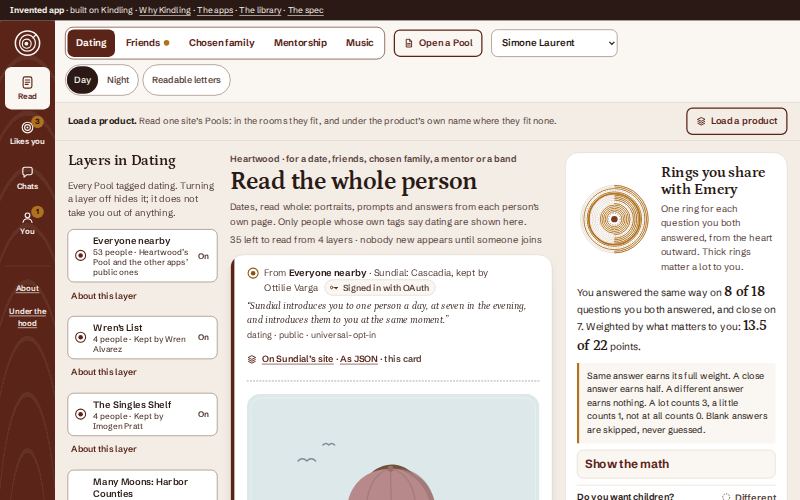
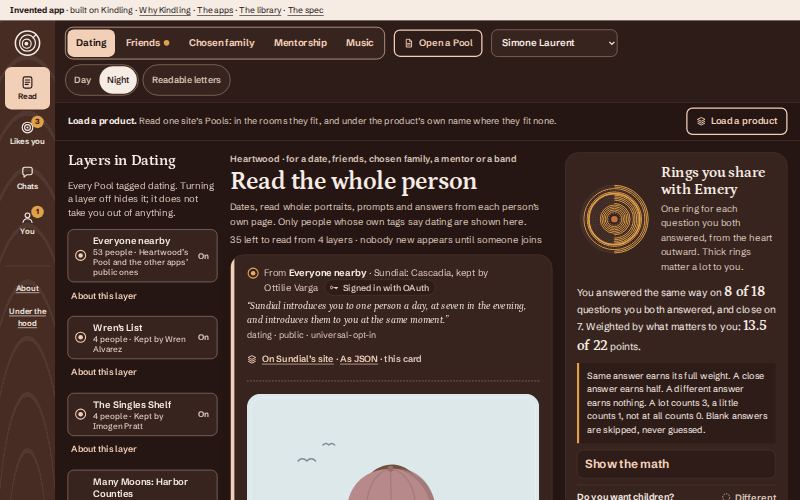
Read the whole person, and the rooms they belong to: Dating, Friends, Chosen family, Mentorship and Music. The rooms are shortcuts: any other Pool opens as a room of its own, and each yes says what it is for.
Pools Hosts Heartwood: Nearby and Heartwood: Friends nearby. Opens 65 Pools that other people keep, in its rooms or under their own names.
Money Member-supported: people chip in what they like, once a year, and every feature is the same for everyone.
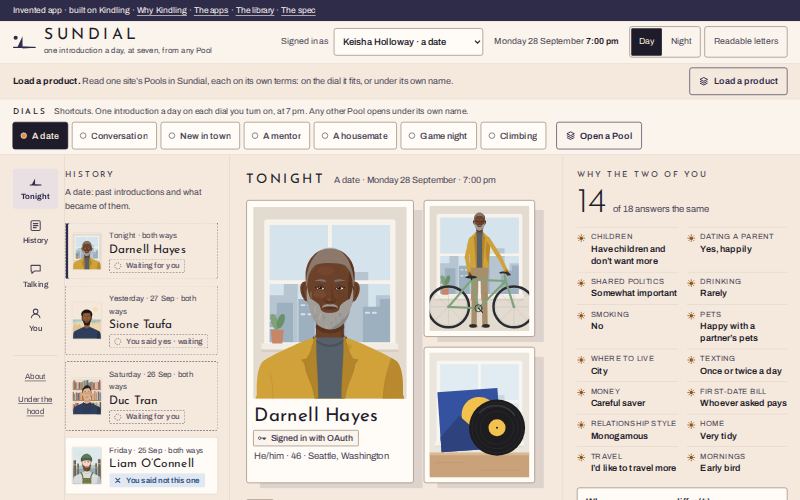
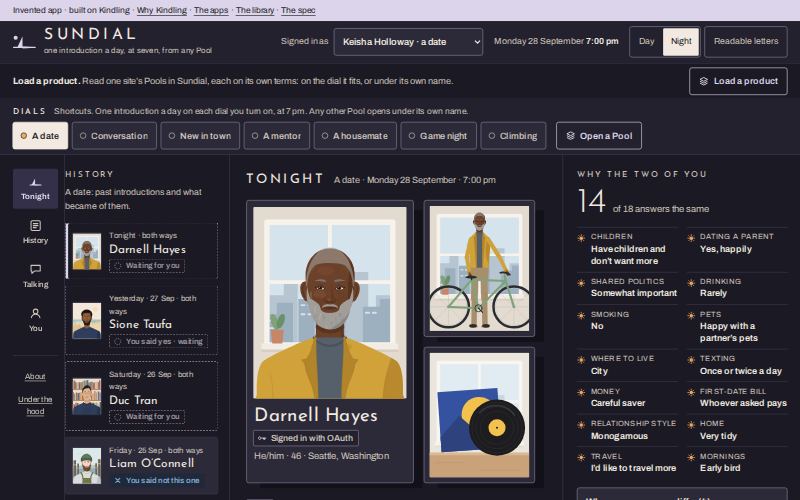
One introduction a day, at seven in the evening, on each dial you turn on: a date, a conversation partner, someone new in town, a mentor, a housemate, a seat at game night or a climbing partner. Both people see it at the same moment where both asked for that. Say yes, or not this one.
Pools Hosts Sundial: Cascadia, and introduces both ways only from it. Opens 66 Pools that other people keep, one way, on its dials or under their own names.
Money Free up front. Thanks come after it works, from people who met someone.
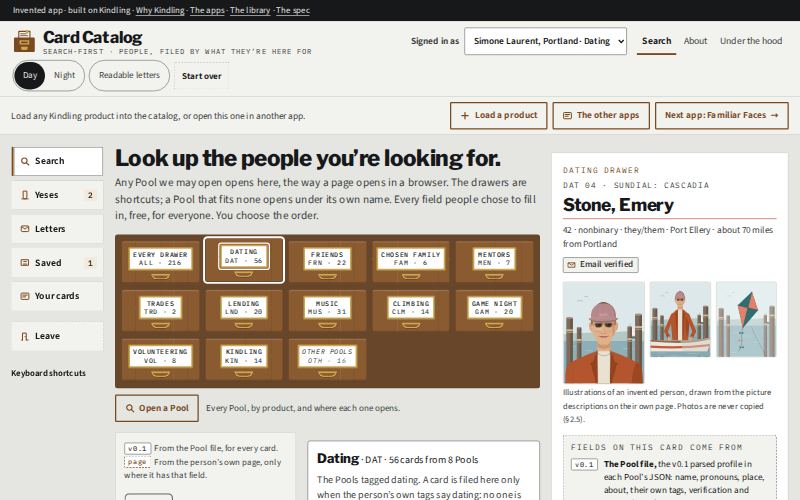
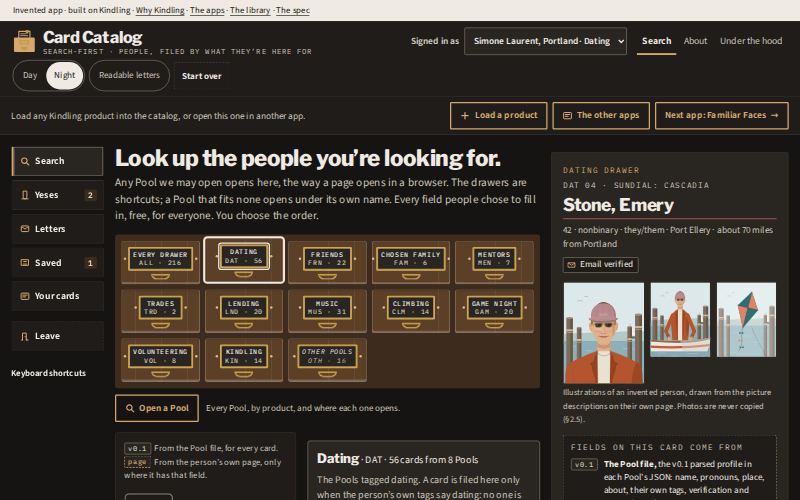
A catalog of every Pool it may open, 67 of them, run like a library: search every field people chose to fill in, free, in an order you choose. Its eleven drawers are shortcuts, dating one of them, and a Pool that fits none is filed under its own name.
Pools Hosts Card Catalog: Cascadia. Opens 66 Pools that other people keep, in its drawers or under their own names.
Money A nonprofit. Every field, every drawer and every feature is the same for everyone.
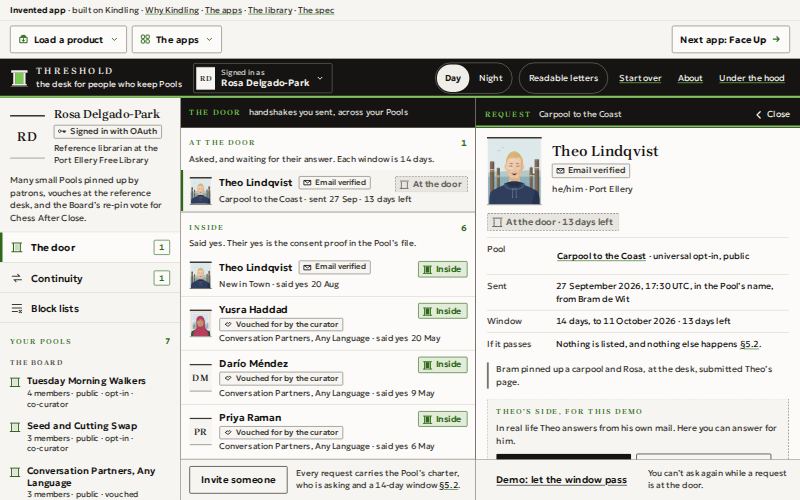
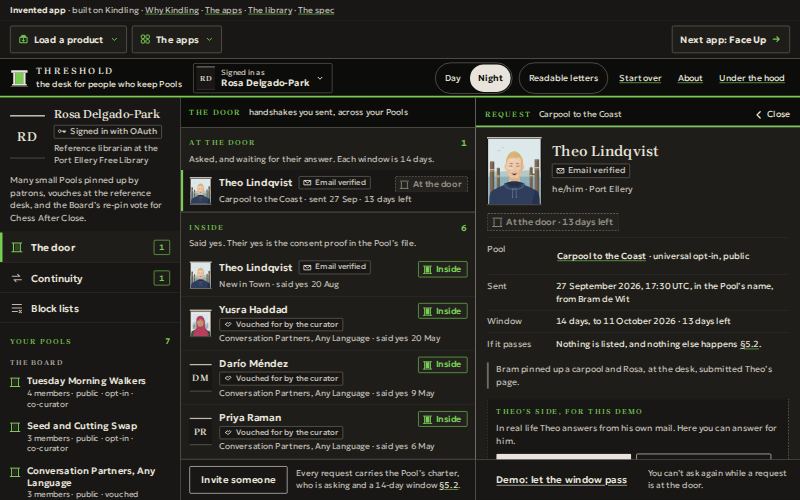
The desk for curators, stewards, coordinators and matchmakers: the queue, the 14-day clock, proposals, vouches, and the Pools that have gone quiet. Members never need it.
Pools Hosts no Pools. It opens each Pool only for the curators named in its own manifest.
Money Free for volunteer curators. Organizations that keep many Pools may pay for a shared desk.
Face Up, Heartwood, Sundial and Card Catalog read many kinds of Pool: a climbing gym’s belay partners, a board-game group’s Thursday tables, a college’s mentors, a musicians’ list, a letter co-op, and dating, where they compete head to head with the leading apps. Each works like a browser: it opens any Pool it is allowed to open, the way a browser opens any page. Its modes are shortcuts, not gates, and a Pool that fits none of them opens under its own name.
Face UpSeven decksDating, Climbing, Saturday Run, Bandmates, Game night, Walking and MentorsOpens 67 of the library’s 70 Pools, 41 of them under their own names. Which, and why
HeartwoodFive roomsDating, Friends, Chosen family, Mentorship and MusicOpens 67 of the library’s 70 Pools, 27 of them under their own names. Which, and why
SundialSeven dialsA date, Conversation, New in town, A mentor, A housemate, Game night and ClimbingOpens 67 of the library’s 70 Pools, 42 of them under their own names. Which, and why
Card CatalogEleven drawersDating, Friends and neighbors, Chosen family and home, Mentors, Trades, Lending, meals and rides, Music, Climbing and running, Game night, Volunteering and crews and The Kindling projectOpens 67 of the library’s 70 Pools, 7 of them under their own names. Which, and why
One Pool, three layers: a page on its host’s own site, a JSON file anyone can read, and a card in any app that opens it. The four follow two rules for the third layer. They are written up as a draft proposal for the spec, “Reading a Pool on its own terms”. It is a draft, not part of the published specification, and nothing in v0.1 requires it yet.
Every card shows the Pool’s name, charter and tags.
And its visibility and its curator, with a link to the Pool on its host’s own site and one to its JSON. The page, the file and the card are three views of one yes, and a yes on a card is a yes in that Pool, for what that Pool is for.
No one is shown as open to dating unless their own tags say so.
Being in a Pool tagged dating is not enough. A matchmaker listed in her own Pool, or friends listed with a household, are never dealt as dates, and someone in a climbing Pool is open to a date only if their own tags say dating.
Everything else is already in the specification, and every reader follows it. An invite-only Pool is never read, and an unlisted one only for someone in it or given its address (§3.2). A yes goes the way the Pool says, through a curator or steward where its charter says so (§5.4), and each person’s own rules decide who may write to them (§7.2). And where a site asks that no app read one of its Pools, none does: The Check-In Circle at Foul Weather Friends.
Dating is one thing Face Up, Heartwood, Sundial and Card Catalog do, and there they compete with the leading apps head to head. Each hosts one open dating Pool of its own and reads the others’, along with the other public dating Pools in the library. None of them can win by holding people, so each has to win by how it treats them.
There are 8 public dating Pools in the library, with 60 people in them. Face Up, Heartwood, Sundial and Card Catalog each read all four apps’ dating Pools, so a person in any one of them can be found in the others, by their own yes to the Pool they joined and their own tags. Of the 53 people in the four apps’ own dating Pools, 36 said yes to two of them. Sundial introduces both ways only inside its own Pool, because everyone in it asked for one introduction a day, and one way from the others.
Leave one and your page, your Pools, the addresses of the people you met and your conversations stay with you, because none of them lived in the app. Leaving a Pool is a separate thing, one message, done within 60 seconds.
Kindling v0.1 has no message for interest. Its message types are the handshake, an introduction and a reply, so a like stays in the app where you gave it: in this example, 8 in Face Up, 8 in Heartwood, 2 in Sundial, 5 in Card Catalog. That is a gap in the schema, and we say so. What travels is what matters: once two people say yes, they write to each other by email.
One is a deck, one reads the whole person, one sends a single introduction at seven, one is a search box. None sells who likes you, a place higher in line or an undo. Pick the one that treats you best; nobody you met is kept hostage by the others.
Not every site needs an app of its own. Where a site is already the right home for its people, it keeps none, and any reader can still open its public Pools, on the site’s own terms.
Adults with a rare condition find the few others who share it through stewards who vouch for them. The Heron is invite-only, so no app reads it at all. Scattered Light Stewards is public so that a newcomer can find a steward, and any reader opens it for exactly that. Scattered Light is the door.
Pen pals write one slow letter a week, in two languages, and the co-op pairs them by language. Any reader opens its Pools, and a yes there is a letter, held by the co-op until both people want to write, one a week at most. An app of its own would add nothing but noise. Correo Lento is the door.
Art. VWho reads what
Who reads what.
Every Pool in the library, against every app. Each cell is read from that app’s own About page, so this table and the apps can’t disagree. A cell can carry two marks, such as an unlisted Pool whose curator makes the introductions. Some sites also name, on their own pages, the apps that read their Pools. Any app may read a public Pool, and where a site asks that no app read one, none does.
Reads the app reads it, for everyone who uses the app, in a mode its tags fit or under its own name.
Only with the address the Pool is unlisted, so the app reads it only for someone who is in it or gives the app its address.
Through its curator the app shows it, and a yes becomes a request to its curator or steward, because the Pool says introductions go through them.
For context only the app shows it only as context, such as “you’re both in”, and introduces nobody from it.
Members only the app reads it only for the people who are in it.
Its curators Threshold opens a Pool only for the curators named in its own manifest.
Never the app never reads it, by design; the reason is written under the site.
Not read the app does not read it. Familiar Faces and Bellows read the Pools you belong to and the ones kept for asks and offers; each About page says why.
Thursday Night: Women and Nonbinary Climbersunlisted
Only with the address
Only with the address
Only with the address
Only with the address
Never
Never
Its curators
Familiar Faces · Belay Partners: members only. Read only for the people in it, never suggested: asks and offers, which is Bellows’ kind of Pool.
Face Up · Thursday Night: Women and Nonbinary Climbers: only with the address. In the Climbing deck. Its keepers give the address to no app: a member who wants it in an app adds it there themselves. So Face Up reads it only when you paste it, even if you are in it.
Heartwood · Thursday Night: Women and Nonbinary Climbers: only with the address. In the Friends room. Unlisted, and Drip Line gives its address to no app: it asks a member who wants it in an app to add it there themselves.
Sundial · Thursday Night: Women and Nonbinary Climbers: only with the address. On the climbing dial. Drip Line gives the address to no app; a member who wants it in an app adds it herself, and Sundial reads it for her alone. A yes stays in Sundial, and each person’s own rules decide who may write.
Card Catalog · Thursday Night: Women and Nonbinary Climbers: only with the address. In the Climbing and running drawer. Unlisted: its address travels on the card at Drip Line’s front desk, on first and third Thursdays, so we read it for a member or for someone who gives us the address, and only for them (§3.2). Drip Line gives its address to no app: a member who wants to read it here adds it themselves, like anyone with the card from the desk. So this demo doesn’t print it.
Familiar Faces · Thursday Night: Women and Nonbinary Climbers: never. Its keepers ask that no app read it, and its address travels by hand.
Bellows · Thursday Night: Women and Nonbinary Climbers: never. Drip Line names it for no app.
Face Up · The Tuesday Table, Second Chapters: only with the address, through its curator. In the Dating deck. Late Supper’s rules: only a matchmaker proposes, and only people she has met. So a yes here is a request to Nadia Farouk, and nothing goes to the person.
Heartwood · The Tuesday Table: only with the address, through its curator. In the Dating room. Unlisted, and its charter says Nadia, Late Supper’s matchmaker, proposes introductions one at a time. With the address, a yes here is a request to her.
Sundial · The Tuesday Table, Second Chapters: only with the address, through its curator. On the date dial. Only a matchmaker proposes, one introduction at a time. A yes is a request to Nadia.
Card Catalog · The Tuesday Table, Second Chapters: only with the address, through its curator. In the Dating drawer. Unlisted: its address travels from Nadia, to people she has met, so we read it for a member or for someone who gives us the address, and only for them (§3.2). Its governance_rules say only a matchmaker proposes: Nadia makes every introduction, one at a time. Both people say yes, or nothing happens.
Heartwood · Second Chapters: only with the address, through its curator. In the Dating room. Unlisted, and its rules say only a matchmaker proposes. With the address, a yes here is a request to her.
Face Up · Queer Harbor: Dating: only with the address. In the Dating deck. Its address travels from the bar and from friends, and we never guess one.
Heartwood · Queer Harbor: Dating: only with the address. In the Dating room. Unlisted. Its address travels from the bar and from friends, so it opens only for someone who has it.
Sundial · Queer Harbor: Dating: only with the address. On the date dial. Its address travels from the bar and from friends, and Sundial reads it only for the viewer who gives it. One way, by each person’s own rules, and only people whose own tags say dating.
Card Catalog · Queer Harbor: Dating: only with the address. In the Dating drawer. Unlisted: its address travels from the bar and from friends, so we read it for a member or for someone who gives us the address, and only for them (§3.2).
Familiar Faces · Carpool to the Coast: members only. Read only for the people in it, never suggested: asks and offers, which is Bellows’ kind of Pool.
Familiar Faces · Chess After Close: members only. Read for its members, with a notice that it is resting. Nobody can be asked in while it has no keeper.
Familiar Faces · Cape Tarrow First-Gen Alumni: members only. Read only for the people in it, never suggested: asks and offers, which is Bellows’ kind of Pool.
Face Up · Midspan Mentors: through its curator. In the Mentors deck. Midspan’s rules: nobody writes to anyone until a coordinator has asked both people and both have said yes. So a yes here is a request to Josefina “Fina” Arriaga, the coordinator, and nothing goes to the mentor.
Heartwood · Midspan Mentors: through its curator. In the Mentorship room. Vouching-required, and its rules say only a coordinator proposes, one student at a time, and the student is asked first. A yes here is a request to a coordinator.
Sundial · Midspan Mentors: through its curator. On the mentor dial. In Midspan Mentors a coordinator proposes every introduction; nobody writes to anyone until a coordinator has asked both people. A yes is a request to a coordinator.
Card Catalog · Midspan Mentors: through its curator. In the Mentors drawer. Public. Its governance_rules say only a coordinator proposes an introduction, one student at a time, and the student is asked first. A yes goes to Fina.
Familiar Faces · Midspan Mentors: members only. Read only for the people in it, never suggested: asks and offers, which is Bellows’ kind of Pool.
Face Up · Midspan Students: never. Invite-only (§3.2), served only to Midspan’s two coordinators. No app reads it.
Heartwood · Midspan Students: never. Invite-only. Its file is served only to Midspan’s two coordinators, so no app reads it, even with the address (§3.2). A student’s yes to a mentor goes to a coordinator, who knows who is in it.
Sundial · Midspan Students: never. Invite-only, served only to Midspan’s two coordinators (§3.2). Students read the mentors; nobody reads the students.
Card Catalog · Midspan Students: never. Invite-only (§3.2), served only behind the college sign-in to its two coordinators. No mentor and no app reads it.
Familiar Faces · Midspan Students: never. Invite-only: no app reads it for anyone outside it. If one of its members gave us its address, we would show it to its members only; none has.
Bellows · Midspan Students: never. Invite-only, and only Midspan’s two coordinators read it. A mentor never writes to a student; a coordinator asks the student first.
Familiar Faces · Español ↔ English, Português ↔ English, Français ↔ English, Tagalog ↔ English: never. Letters between pen pals have their own home at the co-op. A friends app would add nothing but noise.
Familiar Faces · Friday Subs, Horns and Strings for Records: members only. Read only for the people in it, never suggested: asks and offers, which is Bellows’ kind of Pool.
Familiar Faces · Lend and Borrow, Rides to Appointments: members only. Read only for the people in it, never suggested: asks and offers, which is Bellows’ kind of Pool.
Face Up · The Check-In Circle: never. Foul Weather Friends asks apps not to read the Check-In Circle, and its address travels only by hand. Face Up treats that the way a browser treats a site that asks not to be read.
Heartwood · The Check-In Circle: never. The site asks apps not to read it, and its address travels only by hand. Foul Weather Friends never copies or prints it, and Heartwood treats that the way a browser treats a site that asks not to be read.
Sundial · The Check-In Circle: never. Foul Weather Friends asks apps not to read it, and its address travels only by hand. Sundial honors the site’s word about its own Pool, with the address or without.
Card Catalog · The Check-In Circle: never. Foul Weather Friends asks apps not to read it, and its address travels only by hand, door to door. So we don’t, even with the address, the way a browser leaves alone a site that asks not to be read.
Familiar Faces · The Check-In Circle: never. Its keepers ask that no app read it, and its address travels by hand.
Bellows · The Check-In Circle: never. Foul Weather Friends names it for no app. Its address travels by hand, it is never copied or printed, and who checks on whom is written nowhere else.
Face Up · Meals When It’s Hard: through its curator. Opens under its own name. Hester keeps the list and the calendar: a friend writes to her, with the household’s yes, and she asks the cooks. So a yes here is a request to Hester Oduya, and nothing goes to the cook.
Heartwood · Meals When It’s Hard: through its curator. Opens under its own name. Tagged mutual-aid, meals and cooking. Its charter says a friend writes to Hester, who keeps it, and Hester asks the cooks, so a yes here is a request to her.
Sundial · Meals When It’s Hard: through its curator. Opens under its own name. A friend writes to Hester, with the household’s yes, and Hester asks the cooks. A yes is a request to Hester. Its yes: “Ask through Hester”.
Card Catalog · Meals When It’s Hard: through its curator. In the Lending, meals and rides drawer. Public. Its charter says a friend writes to Hester, with that household’s yes, and Hester asks the cooks. A yes goes to Hester.
Face Up · Platonic Life Partners: through its curator. Opens under its own name. Hearthhold’s stewards make the introductions, slowly, after a call with each person. So a yes here is a request to Mireille Dufresne, and nothing goes to the person.
Heartwood · Platonic Life Partners: through its curator. In the Chosen family room. Vouching-required: a steward meets each person before listing them, and Hearthhold’s stewards introduce. A yes here is a request to the stewards.
Sundial · Platonic Life Partners: through its curator. Opens under its own name. Hearthhold’s stewards introduce. A yes is a request to Mireille.
Card Catalog · Platonic Life Partners: through its curator. In the Chosen family and home drawer. Public. Hearthhold’s stewards make the introductions, after meeting everyone, and every member keeps no_cold_messages on. A yes goes to Mireille, and she asks.
Familiar Faces · Platonic Life Partners: members only. Read only for the people in it, never suggested: not a friendship or community group.
Face Up · Intentional Co-Parents: only with the address, through its curator. Opens under its own name. Hearthhold’s stewards make the introductions, slowly on purpose, after meeting each person twice. So a yes here is a request to Mireille Dufresne, and nothing goes to the person.
Heartwood · Intentional Co-Parents: only with the address, through its curator. In the Chosen family room. Unlisted: a steward gives the address after meeting you twice. With it, a yes is a request to the stewards, who introduce.
Sundial · Intentional Co-Parents: only with the address, through its curator. Opens under its own name. Hearthhold’s stewards introduce, slowly on purpose. A yes is a request to Mireille.
Card Catalog · Intentional Co-Parents: only with the address, through its curator. In the Chosen family and home drawer. Unlisted: its address travels from a Hearthhold steward, so we read it for a member or for someone who gives us the address, and only for them (§3.2). Hearthhold’s stewards make the introductions, slowly on purpose. A yes goes to Mireille, and she asks.
Familiar Faces · Intentional Co-Parents: only with the address. Unlisted: only if a member gives us its address, and none has.
Face Up · The Orchard Street Household: only with the address, for context only. Opens under its own name. Its charter lists the household “so the people we date can see how we are connected”. Face Up shows it for that and nothing more: no yes here, and no hello through it.
Heartwood · The Orchard Street Household: only with the address, for context only. Opens under its own name. Tagged household and non-monogamy. Its charter lists the household “so the people we date can see how we are connected”, so it is read for context only: a member who links it shows it as one line on their card, and under its own name it has nothing to say yes to.
Sundial · The Orchard Street Household: only with the address, for context only. On the date dial, as context. Its charter lists the household “so the people we date can see how we are connected.” Nobody is introduced from it; on a date card of one of its members, it shows the household, for a viewer who has its address.
Card Catalog · The Orchard Street Household: only with the address, for context only. Opens under its own name, in Other Pools. Unlisted: its address travels only from the household itself, so we read it for a member or for someone who gives us the address, and only for them (§3.2). Its tags, household and non-monogamy, fit none of the drawers, and it asks for no introductions. Its charter says it is listed for context, to show how its members are connected. So we show who is connected, each on their own card, and introduce nobody from it.
Familiar Faces · The Orchard Street Household: only with the address. Unlisted: only if a member gives us its address, and none has.
Familiar Faces · Scattered Light Stewards, The Heron: never. Peer support for a rare condition, with its own home. The stewards and the Heron circle are not a friends app’s to read.
Face Up · The Heron: never. Invite-only (§3.2): its address travels only from a steward to a newcomer, and no app reads it, even with the address.
Heartwood · The Heron: never. Invite-only. Its address travels only from a steward to a newcomer and is in no discovery file, so no app reads it, even with the address (§3.2).
Sundial · The Heron: never. Invite-only, and its address travels only from a steward to a newcomer (§3.2).
Card Catalog · The Heron: never. Invite-only (§3.2). Only its members can see it, and its address travels only from a steward to a newcomer.
Bellows · The Heron: never. Invite-only. It has its own home, and no app reads it.
Face Up · Seen Work: Harbor Trades: only with the address, through its curator. Opens under its own name. Seen Work’s rules: contractors never see this list; they ask a curator, who asks members one at a time and introduces only those who say yes. So a yes here is a request to Delphine Arceneaux, and nothing goes to the person.
Heartwood · Seen Work: Harbor Trades: only with the address, through its curator. Opens under its own name. Tagged trades, referrals and work. Its rules say contractors ask a curator, who asks members one at a time, so a yes here is a request to a curator.
Sundial · Seen Work: Harbor Trades: only with the address, through its curator. Opens under its own name. Contractors ask a curator, who asks members one at a time and introduces only those who say yes. A yes is a request to Delphine.
Card Catalog · Seen Work: Harbor Trades: only with the address, through its curator. In the Trades drawer. Unlisted: its address travels between Seen Work’s members and curators, so we read it for a member or for someone who gives us the address, and only for them (§3.2). Its governance_rules say contractors ask a curator, who asks members one at a time and introduces only those who say yes. A yes goes to Delphine. Its rules say contractors never see this list and ask a curator instead. So even with its address we show its cards only to its own members; everyone else sees its curators, in Seen Work Curators.
Familiar Faces · Seen Work: Harbor Trades: only with the address. Unlisted: only if a member gives us its address, and none has.
Bellows · Seen Work: Harbor Trades: members only. The trades circle itself. Unlisted, so Bellows reads it only for its own members, and asks still go through a curator.
Familiar Faces · Seen Work Curators: members only. Read only for the people in it, never suggested: asks and offers, which is Bellows’ kind of Pool.
Familiar Faces · Slack Water 2025: members only. Read for its members, with a notice that it is resting. Nobody can be asked in while it has no keeper.
Familiar Faces · Rides Home: members only. Read only for the people in it, never suggested: asks and offers, which is Bellows’ kind of Pool.
Familiar Faces · Founding Curators, Client Builders, Spec Readers, Toward a Working Group, Writers and Researchers: members only. Read only for the people in it, never suggested: the Kindling project’s own working Pools.